1 · Why IN718
Inconel 718 (Chinese equivalent GH4169, UNS N07718) is strengthened by γ″-phase (Ni3Nb) age-hardening precipitation, delivering high strength, creep resistance and corrosion resistance together across a wide window from -250 °C to 650 °C — still the world's largest-volume precipitation-hardened nickel superalloy.
For AM, 718 is mostly supplied as spherical powder via VIGA/EIGA or plasma rotating electrode (PREP). LPBF uses 15-53 μm; blown-powder cladding commonly uses 45-105 / 53-150 μm. Printed parts recover full strength after solution treatment plus double aging (954 °C solution + 718/621 °C aging).
718's engineering pain points differ from titanium: hot-crack sensitivity (Laves phase and Nb segregation are the crack sources), as-printed anisotropy, and aging-schedule batch sensitivity — precisely where buyers pay a premium for a "stable batch".
Mind the grade family: Inconel 625 is solution-strengthened (corrosion-first, one strength tier lower), and 718Plus pushes the service temperature higher — prices and uses differ; do not mix them in one inquiry. Domestic GH4169 and imported Inconel 718 belong to one material system; the price difference sits mostly in certification and batch data, not chemistry.
2 · Platform Quote Profile
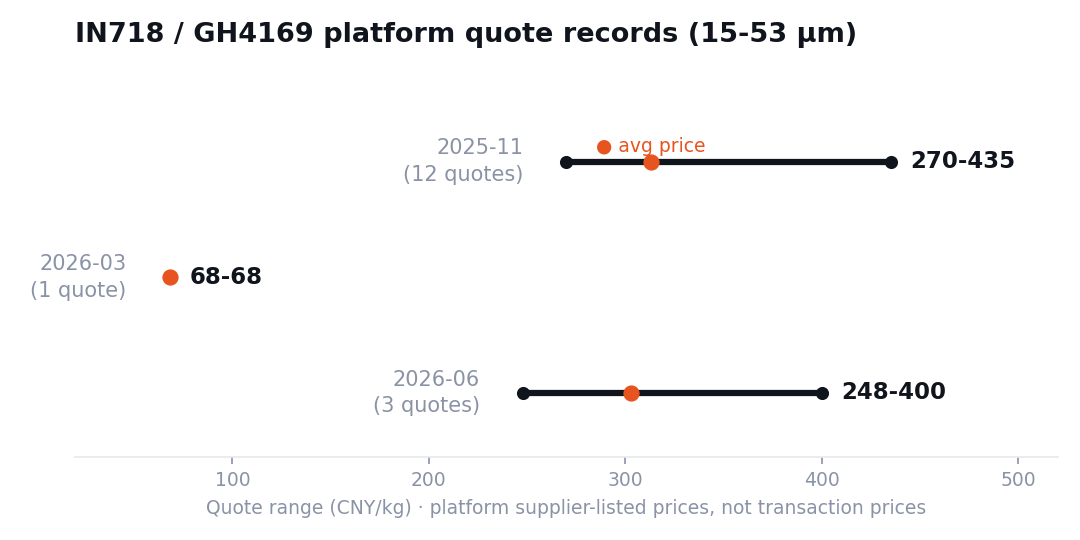
Platform quotes are supplier-listed, not transaction prices, displayed with a 30-day delay per platform policy and retired after 30 days; price statistics run through June 2026. The 15-53 μm records cover 4 record dates and 16 quotes:
First, the mainstream band is stable. November 2025: 12 quotes at 270-435 CNY/kg, average ≈313; June 2026: 3 quotes at 248-400 CNY/kg, average ≈303. Half a year apart, the bands nearly overlap — the center of gravity has not moved down meaningfully.
Second, 68 CNY/kg is a lone outlier. March 2026 recorded a single 68 CNY/kg quote, roughly 4x below the mainstream band, data quality marked "medium". No atomization route or test information accompanies it — comparing it directly with mainstream powder is meaningless. Request full elemental and oxygen reports before any comparison.
Third, layering inside the nickel family is clear. Same-period records show GH3536 at 270-780 CNY/kg (3 quotes) and GH4033 at 400-800 CNY/kg (3 quotes). Among nickel superalloys, 718 has the narrowest band and the lowest center — the biggest-volume grade sees the most competitive quoting.
3 · Demand-Supply Temperature Gap
| Time | Inquiry | Quantity | Quotes received |
|---|---|---|---|
| 2025-11 | INCONEL 718 powder 15-53 μm (overseas customer) | 500 kg | 12 |
| 2025-12 | University bidding: TC4 / 18Ni300 / GH4169 bundle, 15-53 μm | 90 kg (GH4169) | bidding |
| 2026-03 | IN718 nickel superalloy powder purchase | not stated | 0 |
| 2026-06 | Inconel 718 wire / bar (non-powder) | not stated | 4 |
| 2026-08-18 | Nickel powder small-batch custom (new today) | 10 kg | 0 |
The gap runs in two directions. The overseas 500 kg inquiry came with a clear specification (15-53 μm) and 12 quotes landed the same day; the two domestic needs — the March IN718 purchase and today's 10 kg custom batch — stated grade or quantity too thinly and drew zero quotes. The more complete the specification, the faster suppliers respond; an inquiry with only a grade name and no particle size, oxygen limit or use case cannot be priced. Note also that March's 68 CNY/kg lone quote and March's zero-quote inquiry appeared on the same day: demand waits for suppliers, while the cheap outlier waits for a test report.
4 · Utilization Decides Real Cost
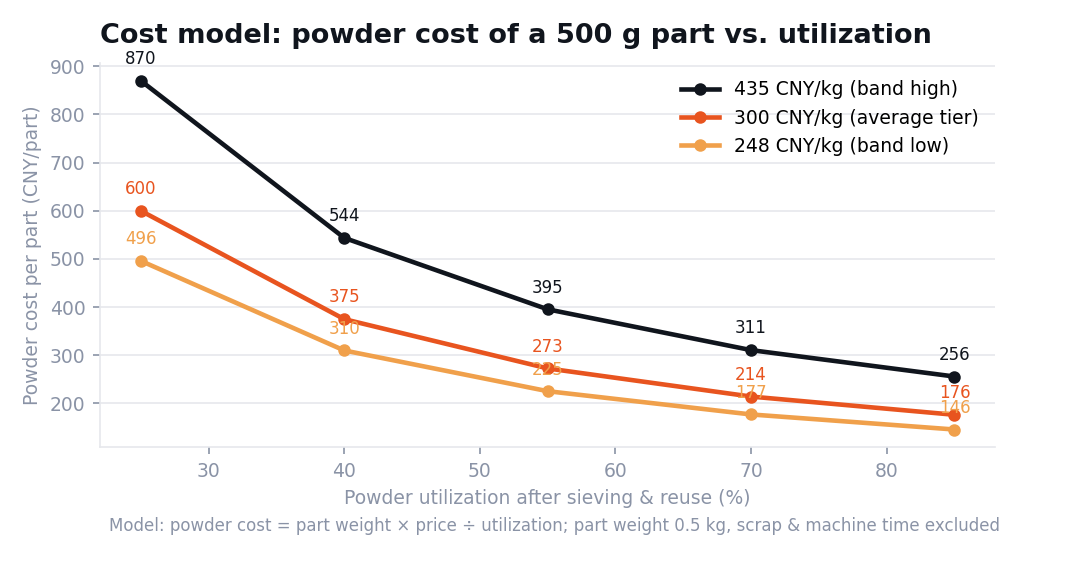
718's unit price is the most transparent in the nickel family, so the first cost lever is not unit price but powder utilization — unsintered powder is sieved and reused after LPBF, and utilization (effective powder consumed ÷ total loaded) varies widely between shops. Model: powder cost = part weight × unit price ÷ utilization, for a 500 g part:
First ledger — utilization 40%: at 435 CNY/kg, powder cost is 544 CNY per part; at 248 CNY/kg it is 310 CNY — a 75% unit-price gap becomes a 234 CNY cost gap. Second ledger — same powder, utilization 25%→55%: at the 248 CNY/kg tier, per-part cost drops from 496 to 225 CNY, saving 271 CNY — more than switching to cheaper powder would save. And 718 is hot-crack sensitive: batch fluctuation in a cheap powder converts directly into scrapped parts. Cutting price 5% loses to doing reuse properly.
5 · Application Map of 11 Listed Products
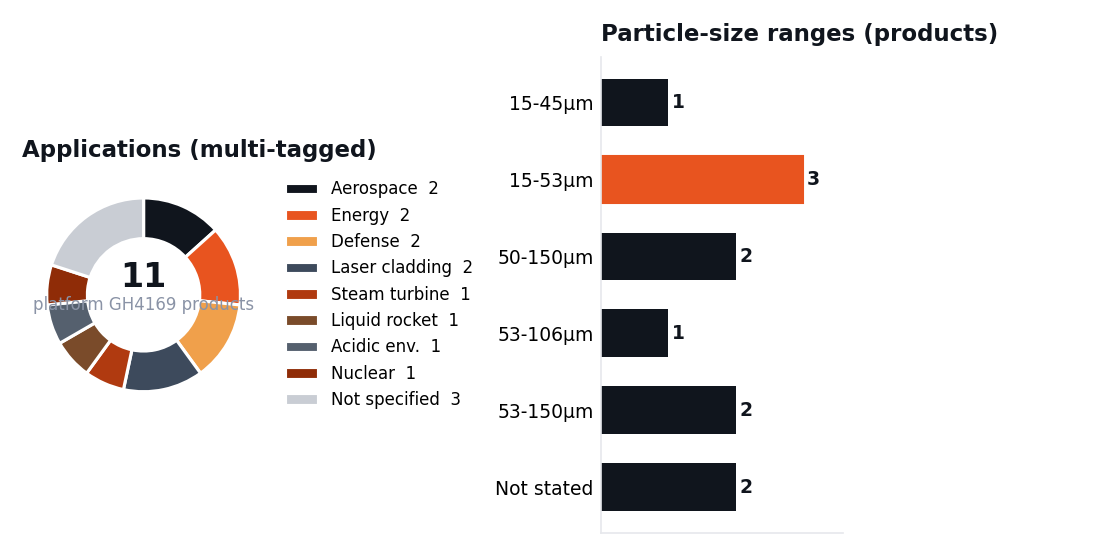
Three observations. Applications cover the aerospace-energy main battleground — aerospace, energy and defense tag 2 products each; steam turbine, liquid rocket, acidic environments and nuclear 1 each. The particle-size spectrum layers by process — 15-45 / 15-53 μm serve LPBF precision printing (4 products), 50-150 / 53-150 μm serve laser cladding and blown powder (4), with 53-106 μm in between (1). Among declared routes, VIGA appears on 2 products and SS-PREP® (plasma rotating electrode) on 1 — PREP powder has the fewest satellites and commands the highest price, suited to surface-critical parts. Note: platform GH4169 products currently carry no USD listings; for export pricing see the international comparison below.
6 · Two Price Tables: Home vs. Abroad
Looking internationally (listing snapshots collected Jul 2026, supplier names withheld): same grade, 15-53 μm — domestic GH4169 at about $44.5-49/kg, import-grade (North American supplier) at about $128-149.5/kg — a 2.9x gap for the same grade. European public-platform listings add another angle: China-origin ≈545 CNY/kg (€69.46), Europe-origin ≈424 CNY/kg (€54), India-origin ≈566 CNY/kg (€72.09, at 7.85 CNY/EUR).
Both price tables agree with the domestic 248-435 CNY/kg mainstream band: the gap is not in the powder — it is the pricing power of "certification + batch data + delivery network". Two implications follow. Import substitution: where $128-149.5 imported powder is used, switching to domestic mainstream gas-atomized powder can cut cost by more than half when performance is met. Export pricing: domestic powder listed abroad prices 30-80% above domestic levels — that delta is the recoverable space of certification and service. Mind trade terms: EXW vs. FOB/CIF differ by 3-8% in freight, customs and insurance.
Five industry signals from the past month point the same way:
| Date | Event | Procurement implication |
|---|---|---|
| 8/12 | Domestic GH4169 mass production live (500 t/yr capacity), exporting to Europe & US | Supply ample — long-term price-lock window opens |
| 8/10 | AI compresses 718 process optimization from weeks to days | Powder-switch trial cost falls; suppliers must ship parameter packs |
| 8/5, 8/16 | Nickel-alloy creep-rupture and fatigue-life studies published in clusters | Batch performance curves become a must-check procurement item |
| 8/1 | America Makes $16.5M high-temperature alloy program | Export orders increasingly filter on certification credentials |
| 7/31 | European defense kicks off nickel-powder localization project | During local capacity ramp-up, certified external supply is hard demand |
7 · Four-Point Buying Checklist
8 · Outlook
718's price band is now clear: 248-435 CNY/kg is the domestic 15-53 μm mainstream; the 2.9x home-abroad gap is locked inside certification; the first lever of per-part cost is utilization. Fold test reports, trial-print data and reuse practice into one ledger — that is the real purchasing logic between 248 and 435.
Data notes: material data per AMS 5662 / GB/T 14992. Platform quotes and inquiries are from PowderSight public records; price statistics through June 2026, inquiry snapshot 2026-08-18. Per platform public-price policy, quotes are published with at least a 30-day delay, for market reference only, not real-time quotes. International and European comparisons are Jul 2026 listing snapshots with supplier names withheld. This article is informational and not a price quote.