1 · Why 316L
316L is a molybdenum-bearing austenitic stainless steel — roughly 16-18% Cr, 10-14% Ni, 2-3% Mo. The molybdenum buys two capabilities: pitting resistance against chloride environments and elevated-temperature strength. That combination makes it the widest-coverage grade in metal AM: medical implants, food-contact equipment, impellers and pump bodies, and marine hardware all run on it.
Compared with 17-4PH and 304L, 316L offers a wide print process window, a large supplier base and a clearly tiered price structure — for most companies it is the first grade they print in stainless steel.
One grade is still a product family. Route, oxygen content, PSD and batch consistency all define different products. Lock the specification before comparing prices.
2 · Platform Quote Profile
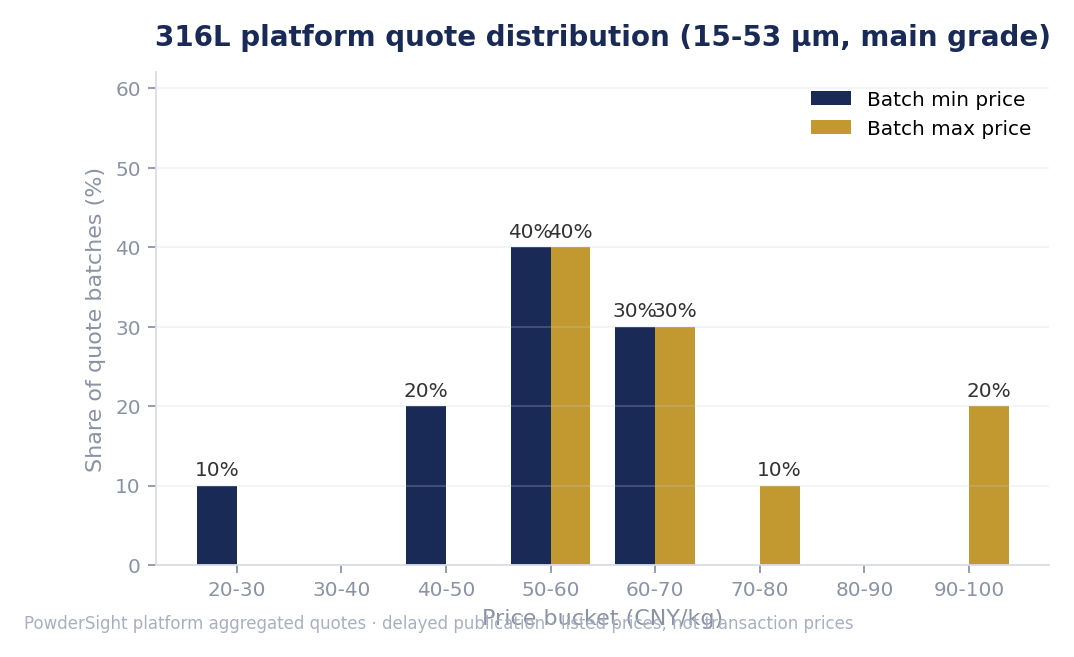
Platform quotes are supplier-listed, not transaction prices, and are displayed with a 30-day delay per platform policy, then retired after 30 days. For the main 15-53 μm grade, three features stand out:
First, the mainstream band is clear. The median sits at 55-63 CNY/kg, consistent with mainstream gas-atomized trading levels. The five 316L products currently on sale quote 55-80 CNY/kg — in line with the historical median.
Second, the spread exceeds 3x. Historical records run 29-100 CNY/kg, and both ends are real supplier quotes rather than outliers — the difference comes from powder production route and quality control, not from market movement.
Third, the band is narrowing and the floor is rising. In the most recent display window, quotes below 40 CNY/kg have been absent for several consecutive periods.
3 · Four Variables Behind the Spread
316L chemistry is fixed and raw-material cost is nearly identical across suppliers — the quote spread comes from route and quality control:
4 · The Scrap-Rate Ledger
Take a 500 g printed 316L structural part. Powder A quotes 60 CNY/kg with 2% scrap (stable process, 400 ppm oxygen); Powder B quotes 40 CNY/kg with 5% scrap (average sphericity, batch fluctuation). Powder cost is 30 CNY vs. 20 CNY per part — B saves 10 CNY on paper. But B's extra 3 percentage points of scrap means 3 extra scrapped parts per 100; at ~300 CNY per scrapped part (powder + machine time + labor), that adds 9 CNY per part. Add trial-run validation and quality-issue handling time, and B's real cost overtakes A. The price on the quotation is only the first line of the ledger.
5 · Two Price Tables: Home vs. Abroad
PowderSight International's current USD quotes for 316L split into two tiers: domestic suppliers EXW at $8.5-9.0/kg (≈61-65 CNY/kg), essentially overlapped with the domestic CNY band; and internationally circulated product at $29.5-37.5/kg (≈212-270 CNY/kg), corresponding to fully certified international brands — the premium comes from AS9100/ISO 13485 systems, full batch test reports and export service.
The two tiers differ 3-4x — the same logic as the domestic 29-100 CNY/kg spread: the difference is not material, it is route, oxygen, certification and consistency. Two procurement implications follow. Import substitution: where $29.5-37.5 imported powder is used today, switching to domestic mainstream gas-atomized powder at 55-80 CNY/kg can cut cost by more than half when print performance is met. Export pricing: domestic 316L exports quote $8.5-9 — the gap to international levels is exactly the space that certification and service capability can capture. Also note trade terms: EXW vs. FOB/CIF differ by 3-8% in freight, customs and insurance.
6 · Inquiry Mix
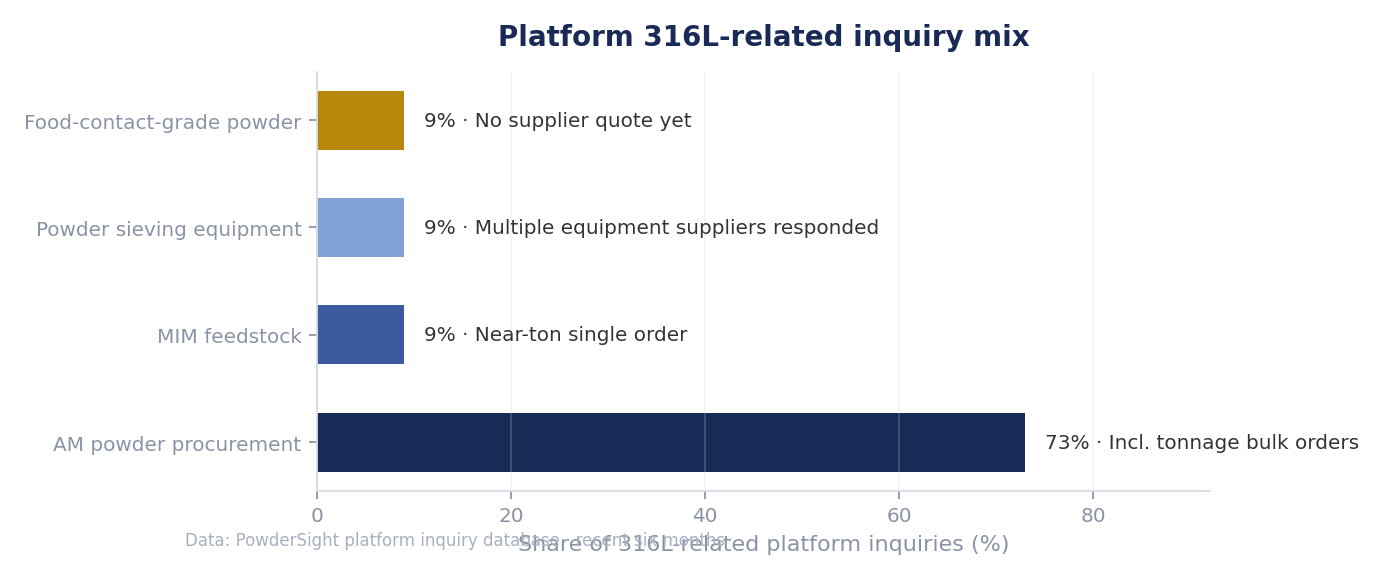
Platform demand splits into four categories. Roughly three quarters is AM powder procurement — including tonnage bulk orders. The rest is food-contact-grade powder, powder sieving equipment and MIM feedstock. One category worth watching: food-contact-grade inquiries have received zero supplier quotes so far — demand is sitting on the platform waiting for a quote that can pass testing.
7 · Five-Point Buying Checklist
8 · Outlook
316L is the most domestically mature AM stainless grade — many suppliers, a wide spread, and concentrated information asymmetry. Ten quote points and two USD tiers already tell the story: comparing prices is the starting line; verifying quality is the finish line. Put test reports and trial-print data into your procurement process, and let "cheapest" give way to "lowest cost per qualified part" — that is the real purchasing logic inside the 29-100 CNY spread.
Data notes: platform quotes are supplier-listed prices (VAT excluded), displayed with at least a 30-day delay per platform public-price policy, for market reference only and not transaction prices. International USD quotes are listing snapshots with supplier names withheld. This article is informational and not a price quote.